
ENCDA Lesson #2: Guiding Principles for a Carbon Data Strategy
Setting your carbon data strategy on the right path.

We are going through a rapidly evolving landscape when it comes to carbon data. In this advent of mandatory climate-related disclosures, the severe adverse reputation risks associated with greenwashing, and increasing consumer/investor expectations for sustainability reports, claims made on sustainability performance need to be evidence-based, data-driven, auditable, defensible, and of a high integrity. A well-defined carbon data strategy provides a foundational mechanism for ensuring any reports and analysis made on carbon performance have these traits, and provide a few other benefits, such as:
Unlocking data for use in a meaningful way
Simplifying the management of large data volumes
Improving organisation-wide data management
Efficient allocation of resources
In ENCDA Lesson #2, we’ll be talking about guiding principles for a carbon data strategy. Principles are the north star for all decision-making when developing, implementing, and maintaining your carbon data strategy, defining a tangible roadmap of goals to work towards.
Guiding Principles
Here’s a great list of guiding data strategy principles. Let’s break these down in the context of carbon data.
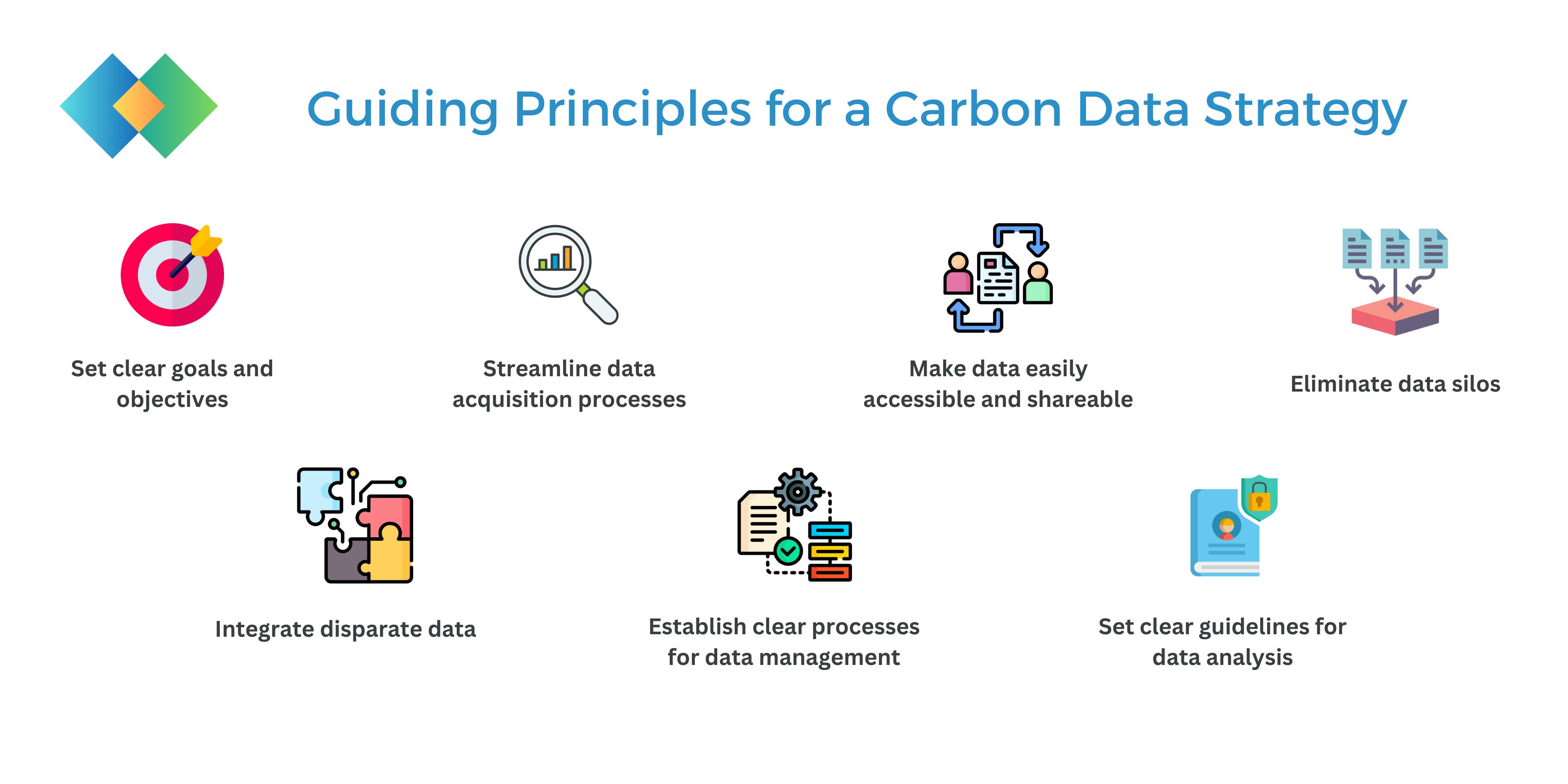
Setting clear goals and objectives for data management and use
Assuming that your organisation has set sustainability targets, this principle is centres around having a clear understanding on what exactly you hope to achieve with a carbon data strategy. In a decarbonisation context, this will commonly be focused on increasing the maturity of data capture, interrogation, and analytics to drive emissions reduction strategy and to adhere to upcoming climate-related disclosure regulations. It is incredibly important to understand what your current state is, define carbon data goals specific to your own organisation based on its appetite and ambition, and align this to wider business goals. You should set short-term goals to monitor progress, and long term goals that define a vision. These goals should relate to each component of your data strategy, including storage, collection, sharing, etc.
For example, for organisations that have a broad brush goal of “Net Zero by X”, then some sample carbon data strategy objectives might be:
Develop a golden-data model for carbon data to act as single source of truth
Improve accuracy of emissions calculations by transitioning from dollar spend data to activity data where possible
Reduce time spent on historic carbon inventory calculations
Develop near real-time carbon performance dashboards to share progress with entire organisation
Strengthen data integrity and data quality
Streamline data acquisition processes
As we spoke about in ENCDA #1, getting a view of the sources of your carbon data is hugely beneficial in providing the ability to easily identify where, when, how, and who the data you need to develop a carbon inventory comes from. Now that we have this map of our data sources, we can begin interrogating it to identify areas of acquisition improvement. Here are some questions to ask:
what are some manual emission source collection methods that could be automated? Can that manual collection of fuel information from our finance team be automated somehow?
are there opportunities to centralise data ownership? how?
where are there opportunities to improve the quality of data to reduce human error?
Make data easily accessible and shareable
Who has access to this data? Who needs access to this data? Are there controls in place to ensure that people only see the data they need to see? It is imperative that a carbon data strategy outlines a way for this information to be easily accessible. Storage is a huge part of this, and making sure that you have a way to store information is an easily retrievable way means that people can access information without needing to create a copy of it for themselves (like multiple excel spreadsheets on separate drives with the same data on it). As we’ll talk about in the next bullet point, consider using a data-aggregation platform (like some carbon accounting tools or things like MS Power Platform) and set some governance in place to ensure that it’s the source of truth for business users.
Eliminating silos
Data silos are probably your current state. They result in you spending weeks on data mergers instead of actual data analysis. There are a number of reasons that data silos exist, such as:
different departments purchasing piecemeal applications without consulting IT
IT teams not having defined Enterprise Architecture controls on the organisation’s application landscape
Technical debt from legacy systems that don’t play nice with newer platforms
Different technologies capturing different data that seemingly have no correlation with one another.
It can be daunting, not to mention expensive, to consolidate everything into once place, however, it is imperative that a carbon data strategy defines mechanisms to overcome silos to improve the ability for meaningful analysis to be done.
Data silos can be consolidated by leveraging a single system that brings in important data for people to access. Modern data-aggregators like carbon accounting platforms are great for this, as they consolidate carbon data into a single place. Using a tool like the Data Source Map provides a reference for the primary source of the data that are then surfaced onto carbon accounting platforms.
Integrate disparate data
Integrations are the next piece of the data silo puzzle, and while a robust integration architecture leveraging APIs and transformations are costly to build, these can be sped up and made significantly cheaper over the long-term using integration platforms like Mulesoft, Fabric, Dell Boomi, etc. These platforms are agnostic of use case, so can be used throughout the entire organisation and not just for carbon and energy. In the interim, it’s perfectly okay for a .csv extract to be sent from a primary data source to a data-aggregation platform, so long as you have visibility of the data sources/frequency/formats/ownership/etc.
An example of this might be integrating fuel purchase data from an ERP system with fleet activity data from a fleet tracking system to get a complete picture of your vehicle fleet’s total emissions profile, or integrating solar analytics data and interval meter data into a single place to get a picture of your organisation’s energy generation vs consumption performance. The list goes on and on.
Establish clear processes for data management
Data governance and ownership is an imperative part in ensuring high quality data is accessible and available for analytics. A strong carbon and energy data foundation underpins an organisation’s decarbonisation effort, and it’s important that there are robust processes in place to protect the integrity of the data being reported, audited, and used to develop strategy.
In a carbon data context, a great place to start is (again using the Data Source Map tool in ENCDA #1) to clearly define the owner of a specific piece of emissions data. It is the owner’s responsibility to ensure that this data point is of a high quality.
A level down from this is ensuring that there are validation processes in place to protect the integrity of data flowing between multiple systems. Examples of this include:
making sure that re-issued utility bills are cleared up so there’s no double entry
emissions calculations are applied consistently over time using the same emissions factors
users are informed of changes to emissions calculations and the reasons why
These ensure that the data is defensible via an audit trail. These processes can be done manually, or automated via software platforms.
In a later lesson, we’ll be breaking down how to develop process maps for carbon data collection and management.
Set clear guidelines for data analysis
Tying everything together, establishing all the components of the carbon data strategy into a set of guidelines for data analysis provide an auditable and defensible mechanism for you and your organisation to analyse your carbon data. These guidelines should encompass aspects such as data quality, security, documentation, ethics, formats, validation, analysis methods, visualisation, and reporting formats. What these guidelines do is standardise the way your interpret and report your data, speeding up reporting time and most importantly, protecting the integrity of your data and analysis.
A few examples of data analysis guidelines for carbon data include:
Using an emissions factor hierarchy that is applied across all data sets
Ensuring consistent calculation methods for data analysis
Documentation of all data collection processes, including primary sources and secondary sources
Security hierarchy for data access
Hierarchy of validation processes that are run on each emissions data source
Further information
Need help putting together a Carbon Data Strategy? Please don’t hesitate to reach out via Substack or send me a message via Linkedin.
If you liked this content and want to be regularly updated, consider subscribing below :)
Disclaimer
The postings on this site/page are my own and do not represent Cairns Regional Council’s opinions, policies or positions.